

In 2026, professional sports are facing one of the most debated performance strategies in modern athletics: load management. Originally designed to protect athletes from overuse injuries, load management has now become a controversial topic among fans, coaches, medical teams, and league executives.
At the same time, soft tissue injuries—especially hamstring strains, groin pulls, and quad injuries—are increasing across major leagues like the NBA and NFL. This combination has sparked intense discussion about whether load management is truly protecting athletes or unintentionally changing the competitive balance of sports.
Recent discussions in athlete health coverage, such as mental health and injury recovery trends, highlight how physical and mental stress are deeply connected in modern sports performance.
Why Load Management Became a Major Strategy
Load management refers to the practice of strategically resting athletes during games, practices, or travel-heavy schedules to reduce injury risk. Teams began adopting this approach after studies showed that fatigue increases the likelihood of muscle injuries and long-term wear-and-tear.
Initially, the strategy was praised. Star players in the NBA and NFL were able to extend careers, reduce stress on joints, and maintain higher performance levels during playoffs. However, by 2026, the approach has become more aggressive and controversial.
Fans argue that resting star players during key games reduces entertainment value and weakens competition integrity. Coaches argue they are protecting long-term athlete health. This tension has become one of the defining debates in modern sports science.
Rise of Soft Tissue Injuries in 2026
Despite load management practices, soft tissue injuries continue to rise. Hamstring injuries alone have become one of the most common causes of missed games across professional leagues.
Experts believe several factors contribute to this trend:
- Increased game speed and intensity
- Year-round training schedules with minimal rest periods
- Travel fatigue across international and cross-country games
- Greater reliance on explosive sprint movements
- Inconsistent recovery protocols across teams
As highlighted in wearable tech injury prevention systems, teams are now relying on real-time biometric data to detect early signs of fatigue and muscle strain.
How AI and Wearable Tech Changed Load Management
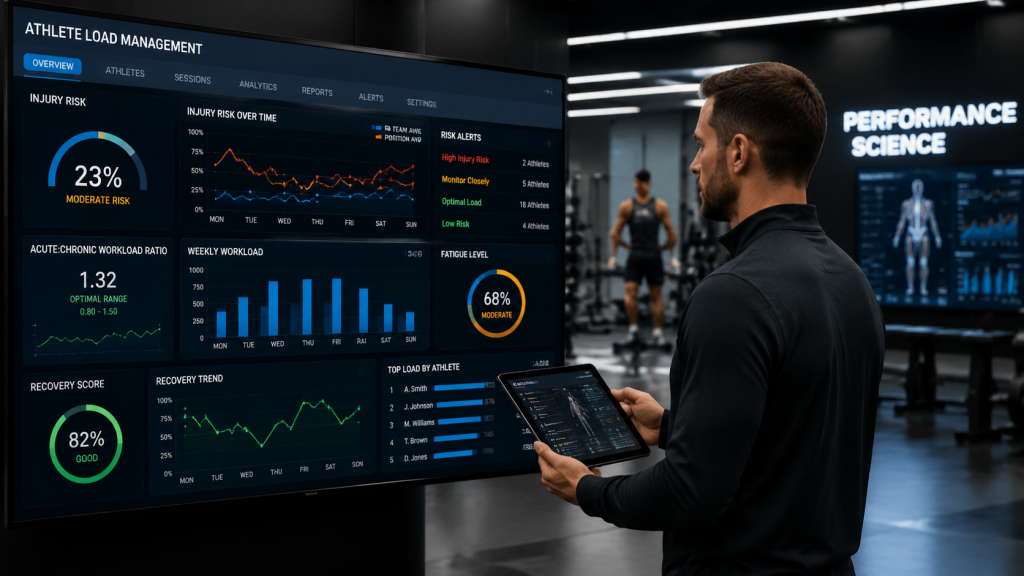
One of the biggest shifts in modern sports is the integration of AI-powered workload monitoring systems. These tools track player movement, acceleration, sleep patterns, heart rate variability, and muscle fatigue.
Coaching staff now receive dashboards that flag players at risk of injury before symptoms even appear. This allows teams to make real-time decisions about rest, training intensity, and game participation.
For example, a player showing decreased sprint efficiency and increased muscle fatigue readings may be automatically flagged for reduced minutes or rest days.
While this technology improves injury prevention, it also raises concerns about over-reliance on data and reduced human decision-making in sports.
More insights into similar systems can be found in concussion awareness and sports safety technologies.
Fan Backlash and Competitive Concerns
One of the most controversial aspects of load management is fan dissatisfaction. Fans expect to see top athletes perform in every major matchup, especially televised or playoff-impacting games.
However, when star players are rested for “preventive recovery,” it often leads to frustration and declining viewership for certain games. League officials have begun exploring rules that limit how often players can be rested for non-injury reasons.
This has created a complex debate: should athlete health or entertainment value take priority in professional sports?
Similar debates were previously seen in discussions around high-profile athlete injury recoveries, where teams carefully managed return-to-play timing under public scrutiny.
The Hidden Problem: Overcorrection in Recovery Science
Some sports scientists argue that load management has gone too far. Instead of preventing injuries, excessive rest may be contributing to decreased tissue resilience.
Muscles, tendons, and ligaments adapt to stress. Without consistent load, athletes may actually become more vulnerable to explosive injuries when they return to high-intensity competition.
This “overprotection effect” is now being studied in both professional and youth sports programs.
It is similar to findings discussed in youth sports injury trends, where inconsistent training loads may increase injury risk rather than reduce it.

Medical Perspective on Load Management
Sports medicine professionals are divided on the issue. Many agree that fatigue is a major risk factor for injury, but they also emphasize that athletes need consistent mechanical loading to maintain performance readiness.
Rehabilitation experts suggest that the best approach is not full rest, but optimized training cycles that balance recovery and controlled stress.
This includes:
- Structured recovery days instead of complete inactivity
- Monitoring muscle readiness through wearable sensors
- Progressive intensity training instead of sudden workload spikes
- Personalized recovery programs based on athlete biomechanics
These methods aim to maintain performance while reducing injury risk without overusing rest protocols.
External Research and Industry Insights
Several organizations are actively studying workload management and injury prevention. Key references include:
- National Institutes of Health sports injury research
- CDC sports safety and injury prevention studies
- National Strength and Conditioning Association guidelines
- FIFA sports science and injury prevention reports
- NBA official health and performance analytics
The Future of Load Management in Sports
Looking ahead, load management is likely to become even more data-driven. AI systems will continue evolving to predict injury risk with higher accuracy, while coaching strategies will increasingly rely on real-time biometric feedback.
However, the challenge will be balancing science with competition. Sports must decide how much rest is optimal without compromising the integrity and excitement of the game.
The next evolution of athlete care will not be about rest alone—it will be about precision load optimization.
Conclusion
The 2026 load management controversy highlights a critical turning point in sports medicine. While the goal is to reduce injuries and extend careers, rising soft tissue injuries and fan frustration show that the system is still evolving.
As technology advances, the future of sports will depend on finding the right balance between performance, recovery, and competition integrity.